Verify Slashing Protection Setup for Solo Ethereum Nodes
If you're running a solo Ethereum validator, you've probably already accepted that the 32 ETH you've locked into the protocol is a long-term bet on the network.
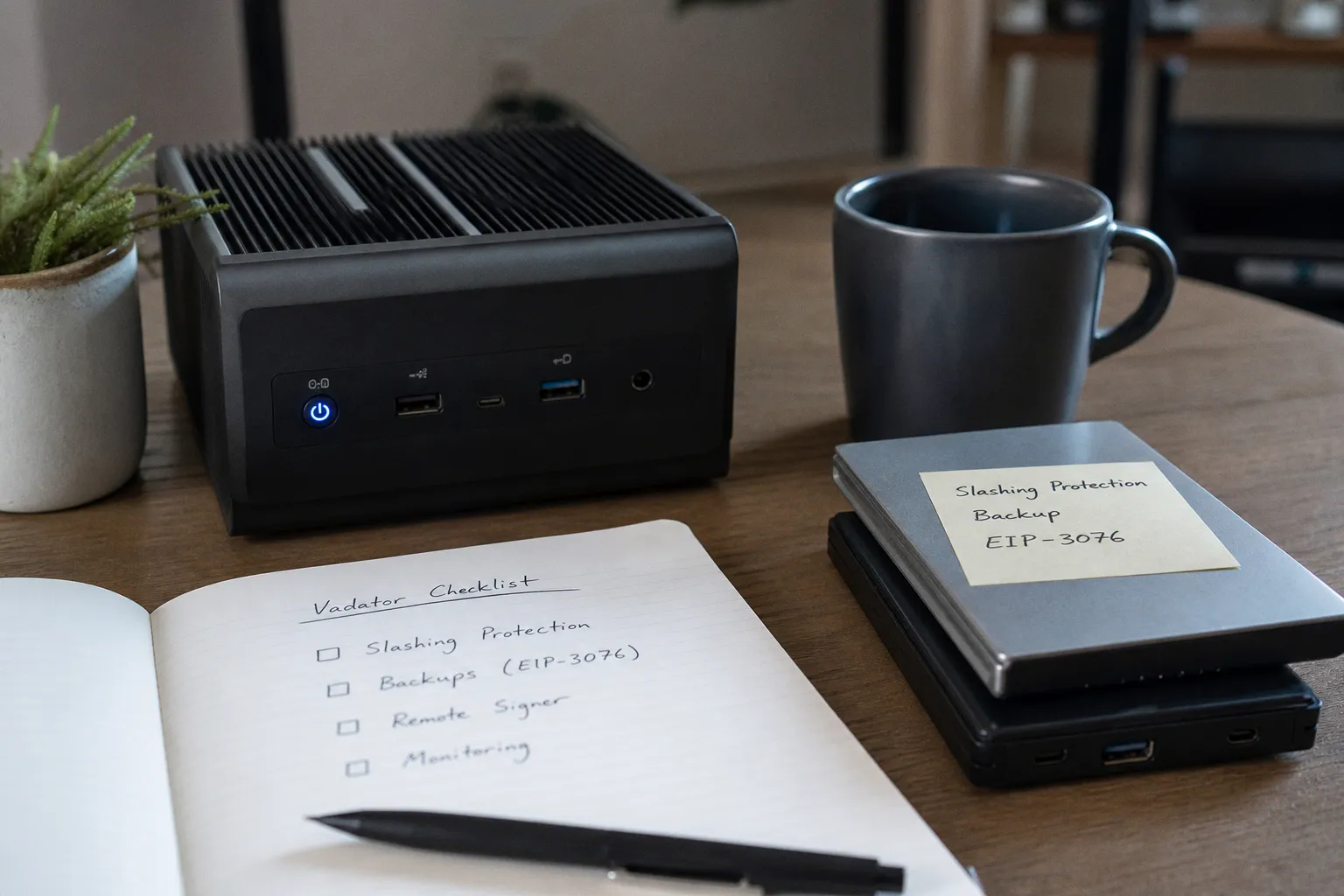
Preventing Double-Signing: A Technical Guide to Validator Slashing Protection
Working through the setup that decides whether your 32 ETH survives a migration
That's the audit I want to walk you through. Not a marketing piece on slashing protection, not a checklist you paste into a runbook and forget. A grounded look at what slashing protection actually does, where it lives in your stack, and what you can do this week to confirm it's doing the job you think it's doing.
The default is your floor, not your ceiling. Verify the database, not just the setting.
The mechanics of double-signing and slashing risks
Before we look at logs and JSON files, it's worth being precise about what slashing protection is protecting you from. The Ethereum consensus rules define a small set of conditions under which a validator can be slashed, and the two that matter in practice for solo stakers are:
1. Double-block proposal at the same slot. A validator is only ever supposed to sign one block per slot. If the same key signs two different blocks for the same slot — even by accident, even milliseconds apart — the protocol will slash the validator and the accompanying stake. This is the classic "two clients running the same key" failure.
2. Conflicting attestations. A validator is supposed to attest to a single chain head at a given time. Two attestations that overlap in a way the protocol calls "surround" or "double vote" will trigger a slash. This can happen if a client has a stale view of the chain, or if a high-availability setup is poorly synchronized.
The penalty for being slashed starts at a minimum of 1 ETH, but in practice scales with how many other validators are slashed around the same epoch — a "correlation penalty" that exists specifically to discourage coordinated misbehavior. For a solo staker, that correlation penalty will usually be small, but the base slash and the forced exit from the validator set are not optional. You don't get to argue your way out of either.
This is the environment slashing protection is designed for. The protection itself lives inside your validator client — the software that holds your signing keys and talks to a consensus node on your behalf. Each major client (Prysm, Lighthouse, Teku, Nimbus) maintains a local database that records every block and attestation your key has signed. Before signing anything new, the client checks that database to make sure the new signature wouldn't conflict with a previous one. The check happens automatically, on every slot, and most modern clients turn it on by default at startup.
That's the protection. It's effective when it works, and it's invisible when it works — which is exactly why it's worth verifying rather than assuming.
Auditing local validator client databases for signing history
If slashing protection is a database check, then verifying it is a database inspection. You want to confirm three things: that the database exists, that it has a meaningful history, and that the client is actively consulting it on startup.
For most clients, the slashing protection data lives in a dedicated subdirectory of the validator's data directory. The exact path depends on the client, but the structure is similar: a slashing_protection or validator/slashable directory containing the historical records of your signed messages. The first thing I'd do is check that this directory isn't empty. An empty slashing protection database on a validator that has been attesting for weeks is a red flag, because it means either the database isn't being written to or you're looking in the wrong place.
The second thing is to look at the client's startup logs. When a validator client initializes, it prints a line — sometimes verbose, sometimes buried — indicating that slashing protection has been loaded. This is the cheapest, most reliable verification you can do. If you see a line that says slashing protection is initialized, the database is present and the client is reading from it. If you don't see that line, dig deeper. The client may have started but the protection subsystem may not be active, and you want to know that before the next slot.
The third thing is to confirm the history is current. A slashing protection database from six months ago is better than nothing, but the protection only covers what it has records of. If you restored a validator from an old backup, or if you imported keys without importing the corresponding slashing protection file, the database will have gaps, and gaps are where double-signs hide.
This is the part of validator operations I think solo stakers tend to underestimate. The protocol doesn't care that your slashing protection was "supposed to be on." It cares whether two conflicting signed messages exist. If the database says you signed block A at slot 1000, the client will refuse to sign a different block at slot 1000. If the database doesn't say anything about slot 1000 — because the record was lost in a migration — the client will sign whatever you ask it to. The system is only as strong as the history it has.
A slashing protection database is a record of promises your validator has already made. The protocol relies on the client to keep that record honest.
Implementing EIP-3076 for secure validator migrations
Most slashing incidents I've seen reported in the wild happen during migrations. You're moving from one consensus client to another, switching consensus node providers, upgrading hardware, or recovering from a machine failure. In each of these cases, you have to move the validator key to a new environment, and the question that determines whether you stay safe is whether the slashing protection history moves with it.
This is exactly the problem EIP-3076 was written to solve. Proposed in 2020, EIP-3076 defines a standard JSON interchange format for slashing protection data. The idea is simple: any validator client can export its slashing protection history as a JSON file, and any other compliant client can import that file and treat it as its own historical record. The format covers all the conditions the protocol checks for — signed blocks, attestations, the highest source and target epochs — so an imported file gives the new client the same protection the old one had.
In practice, this means a migration looks like this: on the source machine, run the client's slashing protection export command, which produces a JSON file representing every signature the key has ever produced. Copy that file along with the validator key. On the destination machine, import the JSON before starting the validator client. The client will read the file, load it into its local slashing protection database, and from that point on refuse to sign anything that conflicts with the imported history.
Two things make this fail. The first is exporting from the source before the source has actually finished writing the most recent attestation. If you export while the old client is still running and still signing, you can capture a partial record. The second is starting the new client before the import is complete. Both of these leave gaps, and gaps are where double-signs occur. The protocol is forgiving in the sense that a single missing attestation won't cause a slash on its own. It is unforgiving in the sense that any missing attestation is a slot where the new client is willing to sign something the old one already signed, and the next slot is the one that matters.
I think of EIP-3076 as the contract between two validator clients. The export is the outgoing client's promise. The import is the incoming client's acknowledgment. Both sides have to honor the contract for the migration to be safe, and the operator — you — is the one who has to verify that the handoff was clean.
Identifying common failure points during failover and redundancy
There's a particular kind of validator operator who wants maximum uptime, and I respect the instinct. The problem is that high-availability setups for solo validators are where slashing protection goes from "on" to "load-bearing," and the failure modes are subtler than most documentation suggests.
The classic mistake is running two validator clients with the same key, both pointed at active consensus nodes, with no coordination between them. Each client is correctly applying slashing protection based on its own database. The trouble is that the two databases are not synchronized. If consensus node A feeds client A a slot that consensus node B hasn't propagated to client B yet, the two clients can end up signing different blocks for the same slot — a textbook double-block proposal. Slashing protection doesn't help here, because each client, in isolation, is doing exactly what it's supposed to do. The protection only works if there's a single source of truth, and a two-client setup without a shared signer or a synchronized database is two sources of truth.
The two patterns that actually work are: a single validator client with redundant consensus node endpoints (so the client can fail over at the network layer without ever starting a second signing process), or a remote signer that holds the keys and is the only thing that actually signs, with the validator clients acting as mere signers. In both cases, the slashing protection database has one writer and one location. That's the property that matters.
If you're running any setup that involves a hot spare, a standby machine, or a script that restarts the validator client on a different host when the primary goes down, you want to look very carefully at the slashing protection synchronization story. Is the slashing protection directory synced to the standby in real time? Is there a lock file or a leader-election mechanism that prevents both hosts from signing at the same time? If the answer to either is no, you're one network blip away from a slash. This is one of those places where capital efficiency and operational discipline are the same thing — the cheapest failover setup is the one that doesn't accidentally sign twice.
Redundancy without a single signing source is not redundancy. It's a second chance to get slashed.
Verifying client-specific slashing protection logs
Different clients surface slashing protection in different ways, and the practical work of verifying it is partly about knowing where to look in your specific stack. I won't claim to have current CLI commands for every client — those change between versions, and I don't want to give you a command that has been renamed in the build you're running. What I can give you is a comparison of how the major clients handle the protection surface, which is the durable part of the picture.
| Aspect | Prysm | Lighthouse | Teku | Nimbus |
|---|---|---|---|---|
| Slashing protection default | On at startup | On at startup | On at startup | On at startup |
| Local database location | Inside validator data dir | Inside validator data dir | Inside validator data dir | Inside validator data dir |
| EIP-3076 export / import | Supported | Supported | Supported | Supported |
| Startup log indicator | Confirms initialization | Confirms initialization | Confirms initialization | Confirms initialization |
| High-availability pattern | Single signer recommended | Single signer recommended | Remote signer compatible | Single signer recommended |
The common thread is that all four clients implement the same standard. The differences are in the directory naming, the log wording, and the operational idioms each client has grown around the same core feature. What I'd actually do, regardless of which client you run, is this: start the client, capture the startup log to a file, and search that file for any mention of "slashing protection" or "slashable." If you find a clean initialization message, you're in good shape for that boot. If you find a warning, an error, or nothing at all, the protection may still be active — clients differ in how loudly they announce it — but you should treat silence as something to investigate rather than something to assume away.
I'd also recommend doing this check after every client upgrade. New versions occasionally change the data layout or the import path, and the moment you find out whether your slashing protection survived an upgrade is the moment of the upgrade itself, not the moment of the next double-sign.
The discipline of verification, and the rest of the picture
A verified slashing protection setup is one of those things that doesn't show up in your yield. It doesn't add basis points to your APY. It doesn't show up in any restaking narrative or in any liquid staking derivative's marketing. What it does is keep the 32 ETH you've already committed in the place you committed it. That's a sustainable baseline, and it's the kind of capital efficiency that compounds quietly over years of running a validator.
Navigating trade-offs is the heart of solo operation. The trade-off here, as always, is time. Verifying your slashing protection setup, exporting and re-importing EIP-3076 files during migrations, sanity-checking your HA configuration, and reading the actual startup logs of your client — all of this is operator time. It doesn't have to be a lot. Most of the audit I'm describing can be done in a single afternoon, and the database check itself is faster than making coffee. The reason I think it's worth doing carefully is that the cost of skipping it is asymmetric: the upside of skipping is a slightly less tedious Saturday, and the downside is a slash event that turns a passive income position into a forced exit.
If you're not sure where to start, the lowest-effort, highest-value action is to log into your validator machine, restart the client, and read the boot log. Confirm that the slashing protection subsystem is initialized, and confirm that the database has recent entries. That single check is enough to catch the most common failure mode — a database that was supposed to be there and isn't. Everything else in this piece is refinement around that core check.
One last thing, and it's not technical. Running a solo validator is an exercise in operational discipline, and the discipline tends to spill over. I find that the same habits that keep a node healthy — checking logs, exporting records, verifying before trusting — are habits that pay off well beyond the validator. If you're someone who wants a different kind of practical reading on operational and life-adjacent topics, nevlanews.com covers a wide range of news, culture, and practical life advice that I find a useful counterweight to the constant monitoring. The validator will be there when you come back. The protection, like the rest of a well-run setup, only works if you've taken the time to look.