Smart contract audit company: manual vs. AI-driven firms
The security market around DeFi has shifted from a relatively simple question — “has the code been audited?” — to a more structural one: what kind of audit, performed by whom, against which failure modes, and with what continuing safeguards after deployment?
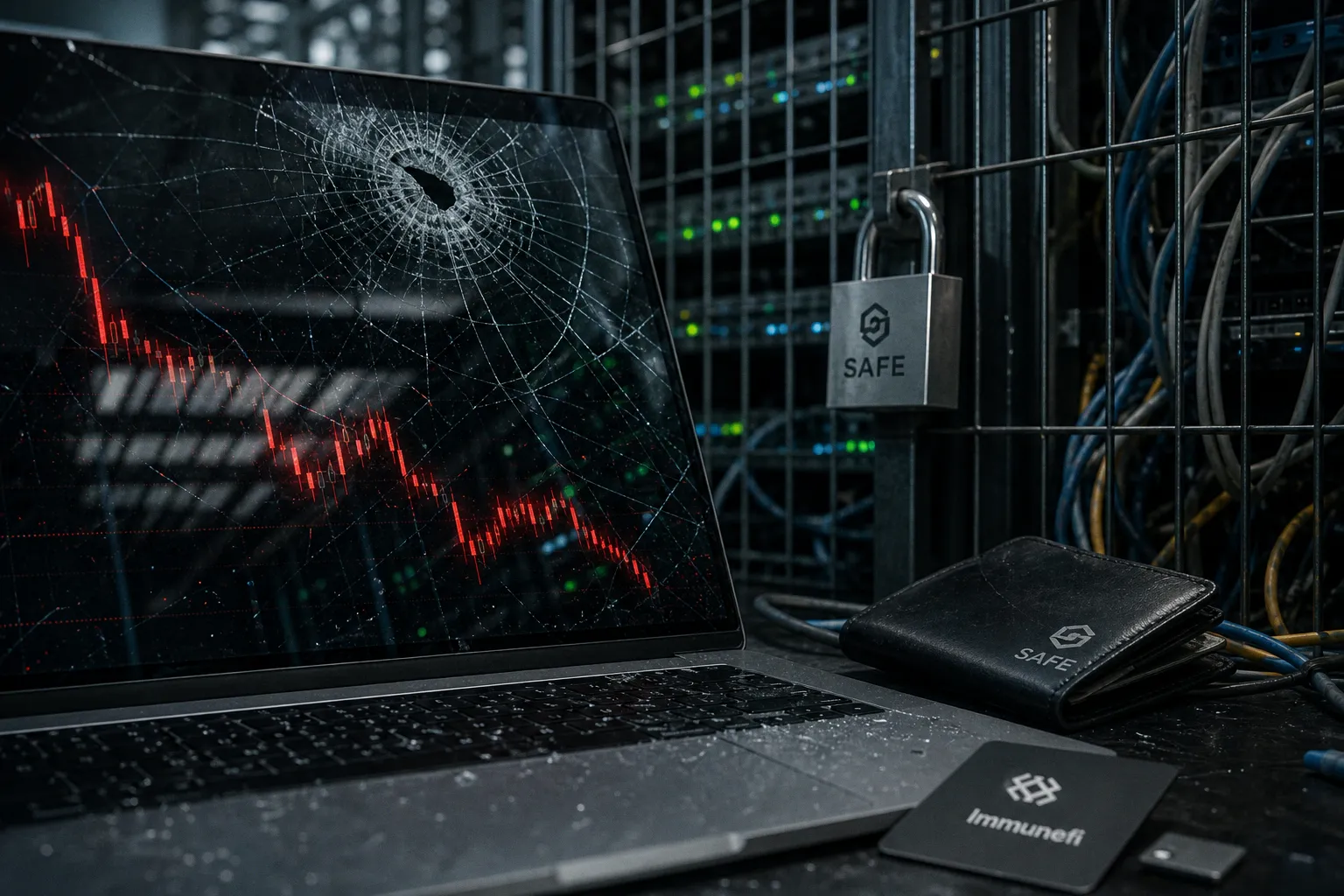
Choosing a smart contract audit company, then, is not a procurement exercise with a neat binary between “human” and “AI.” It is a design decision about how a protocol wants to expose itself to adversarial review. Automated smart contract auditing can move quickly through known vulnerability classes. Manual security teams can reason about system intent, incentives, and business logic. The stronger security posture is usually not one camp defeating the other, but a layered model that accepts the limits of each.
The new audit market is not just faster — it is more stratified
The first wave of DeFi audits was built around expert scarcity. A small number of researchers would review Solidity contracts line by line, produce a report, and attach a reputational signal to the launch. That model still matters. But after DeFi Summer in 2020, demand for professional audit capacity rose sharply, and the market began to split into tiers: established manual audit firms, boutique researchers, automated scanning platforms, AI-assisted review systems, bug bounty marketplaces, and continuous monitoring vendors.
This stratification can be useful, but it also creates a language problem. “Audited” may mean a two-week manual review of a narrow contract set. It may mean an automated scan. It may mean a prior fork inherited an audit, while the new deployment added upgradeable contracts, oracle integrations, and admin controls that were never reviewed in context.
For DeFi, context is not ornamental. A lending market, an AMM, a liquid staking derivative, and a restaking vault may all share libraries and token standards, yet their security surfaces are different. The question is not whether a tool can detect a reentrancy pattern. The question is whether the system’s accounting model, oracle dependency, liquidation path, governance permissions, and liquidity assumptions remain coherent under stress.
An audit is not a certificate of purity; it is a structured confrontation between the protocol’s assumptions and the ways those assumptions may be broken.
That distinction is where manual code review and automated scans begin to diverge.
Where automated smart contract auditing is genuinely strong
Automated scanning tools, including newer AI-assisted platforms, are best understood as pattern recognizers with increasing breadth. Static analysis can inspect code for known vulnerability classes: reentrancy, integer overflow and underflow in older compiler contexts, timestamp dependence, unchecked return values, unsafe delegate calls, access-control mistakes, and certain forms of state inconsistency.
This work is valuable because it is fast, repeatable, and unforgiving. A human reviewer may tire; a scanner does not. A scanner can be run after every commit, in a continuous integration pipeline, before a testnet deployment, and again before mainnet. It can catch regressions that appear when a team refactors code late in the development cycle.
In that role, automated smart contract auditing is not a lesser version of manual review. It is a different security primitive. It compresses feedback loops. It makes common errors harder to ship. It gives engineering teams a baseline that should exist before expensive human review begins.
The practical strengths are clear:
1. Known-pattern detection at speed. Automated tools are efficient at identifying well-understood issues, especially when those issues have recognizable code signatures.
2. Continuous scanning during development. A manual audit often happens in a defined window; automated tooling can operate across the full build process.
3. Consistency across repeated deployments. Protocols launching similar vaults, pools, or chain-specific deployments can use scanning to detect deviations.
4. Early triage before human review. Paying senior researchers to find basic access-control mistakes is an inefficient use of scarce expertise.
5. Regression control. When fixes introduce new problems, automated tests and scans can catch some of the unintended consequences.
The weakness is equally important: automated systems are strongest when the vulnerability resembles something already legible to the tool. Many DeFi failures are not so tidy.
The limitations of automated scanning in complex DeFi logic
Complex DeFi code is not merely software; it is executable financial structure. The hard bugs often emerge from the relationship between modules, not from a single suspicious line. A vault may calculate shares correctly in isolation but become unsafe when paired with a delayed oracle. A rewards distributor may be internally consistent but economically exploitable when liquidity is thin. A governance function may be permissioned, but the signer structure behind it may introduce operational concentration.
AI-driven systems are improving, particularly at summarizing code, finding suspicious patterns, and assisting researchers in navigating large repositories. Still, there is no standardized industry metric that shows exactly what percentage of exploits are prevented by AI compared with manual review. The absence of that metric should make protocol teams cautious about replacing judgment with throughput.
Consider oracle manipulation, one of the persistent causes of DeFi exploits. An automated tool may identify whether a protocol consumes a price feed. It may flag an unsafe dependency on a spot price or a missing staleness check. But the deeper question is architectural: can an attacker move the referenced market cheaply enough to distort collateral values, mint against inflated assets, drain liquidity pools, or trigger liquidations at favorable prices? That question lives across code, liquidity, market depth, and adversarial capital.
The same applies to upgradeability and privileged roles. A scanner can flag owner-only functions. But whether those functions are acceptable depends on the role design: timelocks, multisig thresholds, emergency pause logic, separation of powers, and the probability that a single compromised key becomes a protocol-wide failure. Gnosis Safe-style multisig wallets have become a standard security requirement for treasury and administrative functions precisely because single-key control is too brittle for protocols managing pooled capital.
A simple comparison helps clarify the division:
| Security dimension | Automated or AI-driven scan | Manual expert review |
|---|---|---|
| Known vulnerability patterns | Strong, fast, repeatable | Strong, but less efficient for basic issues |
| Business logic errors | Limited unless patterns are obvious | Strong, especially with protocol context |
| Oracle manipulation risk | Can flag technical symptoms | Can evaluate economic and liquidity assumptions |
| Access-control mapping | Useful for detection | Better for assessing governance and operational design |
| Cross-contract interactions | Improving, but uneven | Strong when reviewers model system behavior |
| Incentive and capital alignment | Generally weak | Central to high-quality DeFi review |
| Continuous monitoring | Well suited | Usually not continuous unless retained |
| Final assurance | Never complete | Also never complete, but broader in reasoning |
The table is not an argument against automation. It is an argument against category confusion. A fast scan is not a substitute for adversarial reasoning, and manual review is not an excuse to avoid machine-assisted hygiene.
Why manual penetration testing remains the industry gold standard
Manual audits remain the industry standard for complex DeFi systems because human researchers can ask a question that static tools do not naturally ask: what is the protocol trying to guarantee, and under what assumptions does that guarantee fail?
That line of inquiry is slow. It usually involves line-by-line code review, threat modeling, test construction, economic reasoning, and repeated discussion with the protocol team. Standard audit timelines often run from two to six weeks depending on codebase complexity, and more intricate systems may need multiple rounds. For a serious DeFi launch, this timeline is not bureaucratic drag; it is the cost of letting external researchers build a mental model of the system.
Manual code review vs automated scan is therefore not just a labor comparison. It is a difference in epistemology. The automated scan asks, “Does this code resemble known danger?” The manual reviewer asks, “What must be true for this system to remain solvent, permission-safe, and internally consistent?”
That difference becomes decisive in several areas:
- Accounting invariants. Does the sum of user claims match the assets the protocol actually controls, especially after fees, rebases, liquidations, slashing events, or reward compounding?
- Share pricing. Can deposits, withdrawals, donations, or flash-loan-funded actions distort share value in a way that transfers wealth between users?
- Oracle design. Is the price source resistant to manipulation, stale data, thin liquidity, and mismatched decimals?
- Admin powers. Can privileged roles upgrade contracts, move funds, change parameters, or pause markets without adequate delay and signer distribution?
- Integration assumptions. Does the protocol rely on token behavior that may not hold — fee-on-transfer tokens, rebasing assets, non-standard ERC-20 returns, or bridge-wrapped collateral?
- Slashing and validator dynamics. In staking and restaking systems, do penalties, validator exits, withdrawal queues, and reward accounting flow through the protocol in a way users can understand and the contracts can enforce?
The best manual auditors do not simply produce a list of bugs. They pressure-test the protocol’s internal constitution. They ask whether the capital flows match the security model. They notice when a system appears technically correct but economically fragile.
This is why a reputable smart contract audit company still commands attention in capital markets. The report is not a guarantee — 100% coverage is impossible — but it is a public artifact showing that qualified outsiders examined the system’s most consequential assumptions.
The rise of hybrid security: AI speed with expert oversight
The more mature framing is hybrid security. In this model, automated tools are used early and often, while manual researchers are reserved for the problems that require interpretation. The goal is not to decorate a manual audit with AI language, nor to market an AI scan as equivalent to expert review. The goal is to allocate different forms of scrutiny to the stages where they are most effective.
A credible hybrid process usually looks less like a single event and more like a sequence:
1. Pre-audit automated scanning. The development team runs static analysis and AI-assisted review before external auditors enter. Basic issues should be removed before the formal engagement.
2. Internal threat modeling. The team defines the core invariants: what cannot be allowed to break, which actors are trusted, how collateral is valued, and how emergency controls operate.
3. Manual audit by external researchers. Security reviewers examine code, architecture, permissions, oracle dependencies, accounting paths, and edge cases.
4. Fix verification. Auditors confirm that remediations actually address the reported issues and do not introduce new ones.
5. Continuous monitoring and bug bounty coverage. After deployment, the protocol remains open to discovery because live market conditions create attack surfaces that are difficult to exhaust in pre-launch review.
This layered model is especially relevant for yield protocols. Passive income strategies in DeFi tend to compress complexity for the end user while expanding complexity underneath. A vault may abstract staking, liquidity provision, hedging, reward harvesting, or leverage. That abstraction is convenient, but it also means users are exposed to the combined failure modes of multiple contracts and integrations.
The more seamless the yield product appears at the surface, the more disciplined its security layers must be underneath.
Hybrid security is also a response to liquidity fragmentation. DeFi capital moves across chains, wrappers, vaults, bridges, and restaking layers. Each additional venue creates new assumptions about finality, asset equivalence, validator behavior, oracle freshness, and withdrawal timing. No single audit method can fully map that terrain. But a layered process can reduce blind spots.
Beyond the audit: bug bounties, multisigs, and operational security
A clean audit report can create a false sense of closure. The better interpretation is narrower: at a particular moment, against a particular codebase, under a particular scope, researchers found and reported a set of issues. After that moment, the system continues to live.
Contracts may be upgraded. Parameters may change. New collateral may be listed. Liquidity may migrate. Oracle markets may become thinner. Governance may transfer control. A protocol that was reasonable at launch can become unsafe through incremental changes that never look dramatic in isolation.
This is why bug bounty programs have become part of the security stack. Platforms such as Immunefi have helped normalize ongoing rewards for white-hat researchers who discover vulnerabilities after deployment. Critical bounties can reach into the millions of dollars, and in some cases above $10 million. The economic logic is straightforward: if a vulnerability can drain a protocol, the legitimate reward for reporting it must be meaningful enough to compete with the illicit alternative.
Bug bounties are not replacements for audits. They are a second market for adversarial attention. Their effectiveness depends on scope clarity, payout credibility, response speed, and whether the protocol can actually pause or mitigate an issue once reported.
Multisig security is another layer that tends to receive less public attention than audit branding, but it is often more decisive in practice. A protocol with excellent contract logic but weak administrative controls can still fail through key compromise or governance capture. Multisig wallets, commonly implemented through systems like Gnosis Safe, reduce single-point-of-failure risk by requiring multiple approvals for treasury movement and administrative actions.
But multisig alone is not a complete design. Thresholds matter. Signer independence matters. Hardware key practices matter. Timelocks matter. Emergency roles matter. If all signers are controlled by one organization, the multisig may be formally distributed but operationally concentrated. If an upgrade can be executed instantly, users have little time to exit or evaluate the change. If the pause guardian can freeze withdrawals without clear limits, the protocol has exchanged one risk for another.
Insurance coverage and DeFi insurance pools may also be part of the security conversation, but they should be treated carefully. Coverage can help transfer some risk; it does not guarantee full recovery after an exploit. Terms, exclusions, claim processes, and available capacity all matter. Security cannot be outsourced entirely to an insurance layer, just as it cannot be outsourced entirely to an audit firm.
Blockchain audit cost comparison is really a risk allocation question
Teams often approach audit selection through price: manual audit firm, AI-driven scan, boutique review, contest, or some combination. That instinct is understandable, especially for early-stage protocols. But blockchain audit cost comparison becomes misleading if it treats all review types as equivalent units.
The true cost is not the invoice. It is the residual risk left in the system after the review is complete.
A low-cost automated scan may be rational for an early prototype or an internal build stage. It is not sufficient for a protocol that will hold significant user deposits, manage leveraged positions, or depend on external price feeds. A high-end manual audit may be expensive and slow, but if the code governs pooled capital, the cost should be weighed against exploit severity, reputational damage, and liquidity flight after a failure.
There are also hidden costs in poor sequencing. If a team sends immature code to a manual auditor, it burns review time on defects that should have been caught earlier. If a team waits until the final week before launch, the audit becomes a ceremonial bottleneck rather than a meaningful design review. If the audit scope excludes peripheral contracts that control upgrades, rewards, or treasury flows, the public report may overstate the system’s actual security posture.
A more useful cost frame looks like this:
| Project stage | Sensible security posture | What it protects against |
|---|---|---|
| Prototype | Automated scans, internal tests, informal review | Basic coding mistakes and obvious unsafe patterns |
| Pre-testnet | Static analysis, AI-assisted review, internal threat model | Regressions, access-control gaps, early architecture flaws |
| Pre-mainnet | Manual audit by credible researchers, fix verification | Business logic errors, oracle risks, cross-contract failures |
| Post-mainnet | Bug bounty, monitoring, multisig governance, incident plan | New vulnerabilities, changing market conditions, operational failures |
| Major upgrade | Renewed manual review plus automated regression testing | Unsafe changes to assumptions, permissions, and accounting |
This is not a rigid maturity model. Some small protocols manage large risk; some large teams ship narrow changes. The point is that audit spending should follow risk concentration, not branding cycles.
What a DeFi team should look for in a smart contract audit company
A serious smart contract audit company should be evaluated less by slogans and more by the way it defines scope, communicates uncertainty, and reasons about adversarial systems. For DeFi, the strongest firms and researchers tend to display a few habits.
They ask for architecture before they ask for a repository link. They want to understand which contracts are in scope, which are excluded, which external protocols are integrated, which roles are privileged, and which invariants the system claims to maintain.
They are explicit about limitations. A good audit report does not imply the system is unhackable. It distinguishes critical findings from informational notes, explains assumptions, identifies unresolved risks, and makes clear that security coverage is not total.
They understand market mechanics. For DeFi security audit firms, code fluency is necessary but insufficient. Reviewers should be able to reason about liquidity depth, oracle manipulation, liquidation incentives, governance powers, staking withdrawals, slashing conditions, and the way capital moves when yields change.
They review fixes. A report without remediation verification leaves too much ambiguity. The fix is often where new fragility enters the system.
They are comfortable with automation but not dependent on it. AI-assisted tooling can accelerate review, but if the provider cannot explain how human researchers validate the tool’s output, the process may be shallow.
For protocols handling meaningful value, the best answer is rarely “choose manual” or “choose AI.” It is to structure the security process so automated tools remove the obvious, human researchers examine the consequential, and post-deployment systems keep the protocol open to challenge.
The unresolved question: security as a continuous market function
The deeper shift is that DeFi security is becoming less like a one-time inspection and more like an ongoing market function. Auditors, AI tools, bounty hunters, multisig signers, oracle providers, insurers, validators, and governance participants all shape the actual risk profile of a protocol. No single actor owns the full surface.
That is uncomfortable, but it is also clarifying. A protocol is not secure because a report exists. It is more secure when its design reduces unnecessary trust, its code has been examined by competent outsiders, its known-pattern risks are continuously scanned, its administrative powers are constrained, and its economic assumptions remain visible as liquidity conditions change.
Manual firms and AI-driven platforms are therefore not opposing futures. They are different instruments in a security architecture that has to match the complexity of modern yield systems. The next question for DeFi is whether protocols will treat that architecture as a launch requirement — or only rediscover it after capital has already found the weakest assumption.